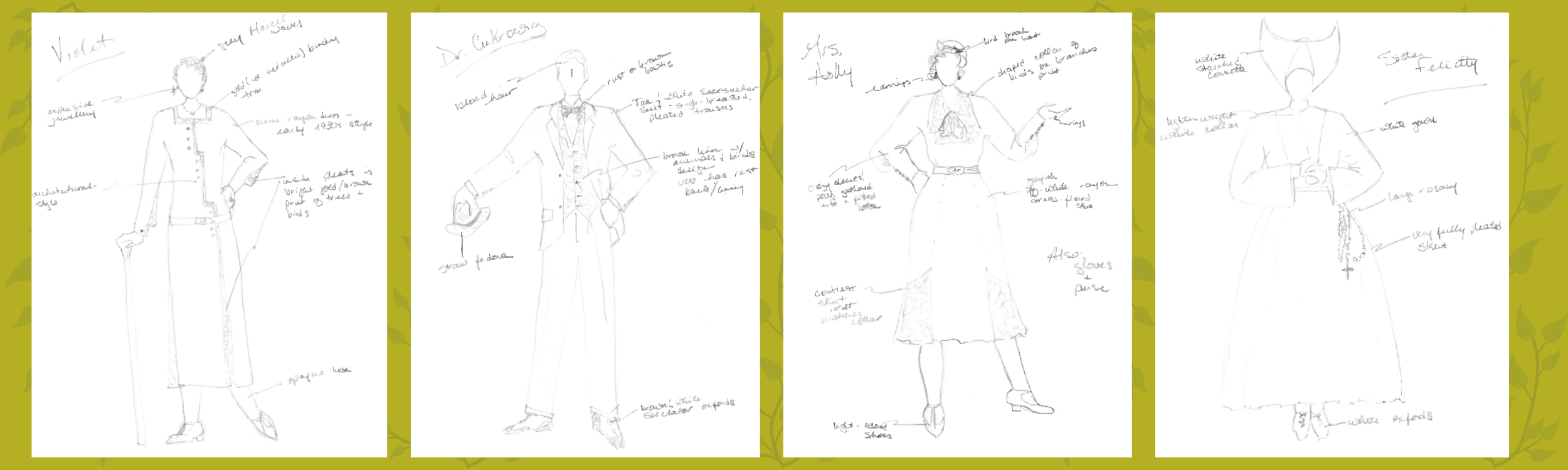
DRESSING THE WORLD OF SUDDENLY LAST SUMMER - BY JENNIVER SPARANO
Our upcoming production, Suddenly Last Summer, although written by Tennessee Williams in the 1950s, takes place in the late 1930s – so even when it premiered, it was a “period play,” i.e., a play that takes place in an earlier time period than the audience’s present. Period plays present a different sort of costuming challenge than do plays that take place in the present.
Perhaps the most obvious challenge is the need for the costumes to help the audience understand when the action of the play takes place. Sure, the setting is printed in the playbill… but often, it’s from the visual design elements of the production – the costumes, the furniture, the props, the décor of the set – that people realize they are being transported back to an earlier time.
Equally important, the costumes can transport the actors back to that earlier time as well. During our rehearsals for Suddenly Last Summer, the cast and production team explored the theme of suppression and control – how both individual characters in the play and the societal expectations of the upper class in 1930s New Orleans try to repress, hide, or eradicate the truth. The discussions and exercises that we used during the process all help the actors understand that society and its strict expectations… but the details of 1930s clothing – the heels, girdles, hosiery, gloves, and dresses worn by the women, or the ties, high-waisted trousers, hats, and hard-soled shoes worn by the men – can make that world and its rules real for them in a very personal way.
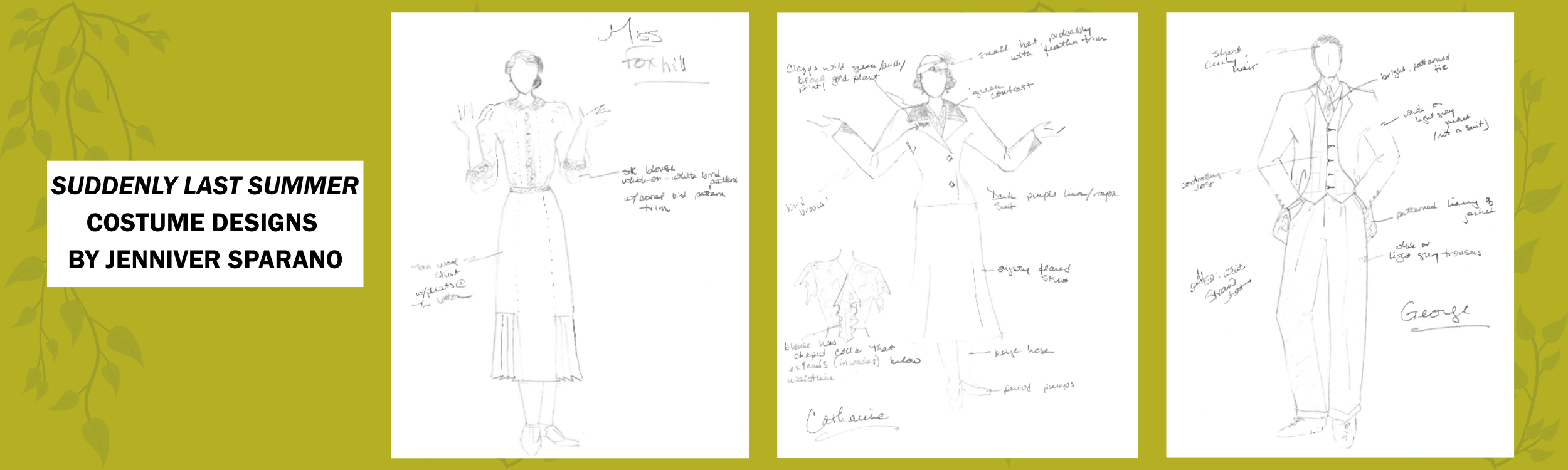
So with a period place, expectations for the costumes are high! Which leads to the real challenge: how do we meet those expectations? This is where the work segues from designing the costumes to executing them. In larger theaters, the costume designer designs all of the costumes, but a team of costume creators – the shop supervisor, the cutter/draper(s), the stitcher(s), the dyer, the crafts artisan – execute the designs to create and fit the costumes. I know costume designers who barely sew – or who just don’t like to do it – and rely on the costume shop to bring the designs to life… but as someone who learned to sew years before I ever started costuming, I enjoy the execution more than the design. So for any show that I design, I also make or buy the costumes. In fact, although I call myself a costume designer, less than 10% of my time on any production is actually spent designing – the vast majority of the time is spent constructing or finding the costumes.
For more recent time periods, actual clothing from the period is available in vintage stores, thrift stores, or the costume collections of various theaters. In the early part of my career (in a different century), that was true for the 1930s as well – I remember using garments from the 1930s in several productions, and even have some vintage dresses from that era in my own wardrobe. That’s no longer the case today, though – actual 1930s garments, when I do see them in vintage stores, are usually priced well beyond my costume budget. Additionally, clothes from the period are now often too fragile to withstand the night-after-night wear onstage – so many theaters that own costume pieces from the early part of the 20th century keep them for study/inspiration only and don’t allow them to be used onstage.
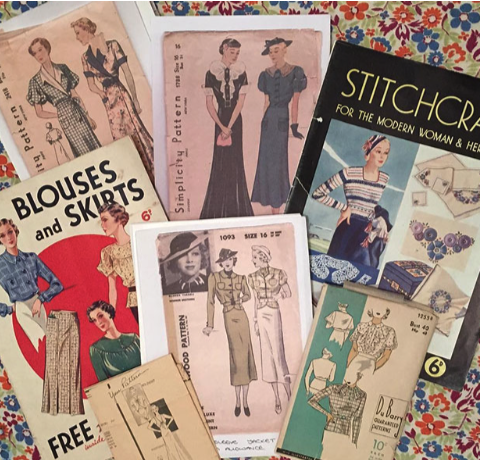
The good news, though, is that it’s become easier to re-create period attire than it once was! It used to be that the only way to get a sewing pattern from the 1930s was through a lucky find in Grandma’s craft room or a garage sale, or by creating it yourself. Today, there are a number of good pattern companies that offer vintage patterns, either re-printed from originals or drafted from existing garments – and they’re all just a click away! Even the “big four” pattern companies serving home sewers – Vogue, Butterick, McCall’s, Simplicity – have re-issued many of their original patterns going back to the 1920s. The costumes worn by the characters of Catharine, Violet, Mrs. Holly, and Miss Foxhill are all made from authentic patterns—including one that actually was a lucky garage sale find years ago!
When making the costumes, I also think about the fabrics that would have been in use during the period. Even the best pattern from the 1930s will look “off” if it’s constructed from the wrong fabric. Natural fibers – cotton, linen, wool, silk – have been used throughout history, so are appropriate to any costuming period. Rayon fabric, which was manufactured in the United States beginning around 1920, was widely used in the 1930s as an alternative to silk. Although polyester fabric was not generally used until after World War II, modern manufacturing techniques create some wonderful polyesters that mimic the feel and drape of rayon or silk, and I’ve used such fabrics very successfully in the past. For Suddenly Last Summer, though, I was able to limit myself to just the fibers that existed at that time. The biggest fabric challenge? Avoiding spandex! In recent years, quite a bit of fabric is made with a small amount of spandex to add stretch – something that did not exist through most of history! When making period costumes, I’ve passed up many a beautiful fabric because of the stretch.
One area where my costumes for Suddenly Last Summer do intentionally deviate from the period is in the designs on the fabrics. One of our production team’s design themes is the encroachment or invasion of the natural world beyond the artificial constructions people make to contain it. So in each of the costumes, I’ve tried to introduce fabrics that feature nature motifs – animals, plants, and especially birds – in contrast to solid colors or geometric designs like stripes. Several of those nature-motif fabrics feature prints that don’t necessarily look like the 1930s – but I think that helps reinforce the “invasion” idea.
Balancing the historical requirements and limitations of the period with the thematic goals of the production – and the realities of what’s available in the 21st century – can be a challenge. But when the costumes meet that challenge, they can help both the actors and the audience enter into the world of a period play and contribute to a richer experience for everyone!