THE MINDSET OF MENACE: BENJAMIN GREGG
I’ve never really had the opportunity to portray multiple characters in a play, or at least not two characters as complex as Major Robbie Ross and James ‘Ketch’ Freeman. Throughout the rehearsal process thus far, I’ve found it challenging to switch between the two characters. They are obviously totally different people, with completely different objectives and perspectives that encapsulate the world of Our Country’s Good.
As we share some of our work this week at GLMCC (Greater Cleveland Michael Chekhov Consortium) the scenes that our ensemble will be presenting all feature Ross as the main antagonist of the play. I will be forthright that when I was first offered the role(s) of Ross and Ketch, I initially had some trepidation about playing Ross. In the second act, we see Ross’s desperation that veers on sadism to re-acquire his grip on power amongst the officers and prisoners. I’ve never really played a character like this and I’m anxious when we enter the final months of rehearsals to see how we plan on staging this brutality and mockery displayed in this scene.
Read More
AN OVERTURE OF TABLEAUX: NATALIE KERN
If I could go back and speak to my younger actor self, one of the things I would try to impart is the high level of trust that directors are placing in you when you are cast in a project. As a young actor, with selfish blinders on, I remember feeling intense imposter syndrome and such insecurity in my own value to the process. Through the years I’d like to think I’ve become more aware of the unique and delicate relationship that is built on trust between an ensemble, directors and designers. We have all been asked to paint with our brightest and deepest color, and we trust that the person(s) watching are discerning enough to see what needs to be adjusted to improve the whole picture.
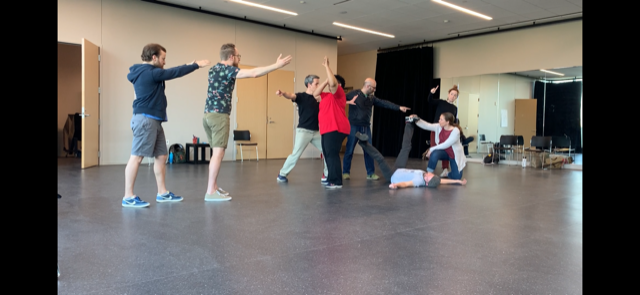
The exercise we’ve been developing recently is a perfect balance of this type of trust-building. Our director and consulting artists have done a wonderful job in scoring out the climaxes and auxiliary climaxes that make up the story we want to tell. We’ve been building a visual overture of sorts as we explore these three main climactic points of the play. Utilizing tableaux, and exploring with transitions, quality of movement, and various other Michael Chekhov approaches, we are attempting to give the audience a visual preview of the story before the play begins. Much like a musical overture will give you an aural preview of the score before the audience has any context.
Read More
PERSPECTIVE: DANIEL MCKINNON
So, I feel that I am coming to this ensemble from a very unique perspective. I have joined this cast - who has been putting hours upon hours of work in through that last year. I am lucky enough to get the chance to join the cast at this stage. I have worked with the Chekhov technique, but the perspective that I get to see them play within this iteration is very unique.
Read More
THE SLOW PACE OF CHANGE: JEANNINE GASKIN
During our May 28th rehearsal, we discussed how the seed of Our Country's Good, or the basic precept that unites the events, is "change". As I thought about this word,I started asking myself questions: Do we really change or is our awareness for something just magnified and it looks like we have changed? Can a person be changed if their peers or society as a whole don't acknowledge or recognize them as being changed? Who are we changing for? Is change really necessary and if so, according to whom?
Read More
ON JEMMY CAMPBELL: JAMES RANKIN
Last rehearsal I chose to begin to work on my character, Captain Jemmy Campbell. I had been avoiding him. He’s difficult to nail down. The text that is presented for him is broken, parroting, passionate, stumbling. A number of his lines are just him stuttering out support of others’ opinions. He seems disconnected, but also deeply lost. Like someone who used to be of import, but now he finds himself in a place where even his words, even with his official title of captain, hold very little sway. I think he understands this.
He could be a drunk, self medicating to cover up his self consciousness. He could be a man with some sort of dementia, struggling to maintain any semblance of who he was. Or he could just be broken.
“Aah-eeh-a. Confusion.” An example of one of his eloquent responses and also how he makes me feel on occasion.
Read More
AN ATMOSPHERE OF PLAY: JEANNINE GASKIN
During one of our rehearsals we finally got to apply our skills we've been learning for months to a scene from the play!
We identified the atmosphere of the scene and applied qualities of movement & psychological gestures with sound.
The scene I worked on with Lana & Natalie was called "The Women Learn Their Lines". In this scene we learn who can read, who can't, who is embarrassed by this, who isn't, and who just wants to keep the peace. Needless to say, the atmosphere was quickly identified as TENSION.
Read More
MUSIC AS METHOD: ABRAHAM ADAMS
The complexity of creating a character cannot be overstated. Similar to other complex endeavors, there is much that remains unseen by those who witness the finished product. My favorite analogy is that of shipbuilding. An ocean liner or an old sailing vessel in the vastness of the sea is a thing of beauty. Consideration is rarely given to what it took to create such majesty.
Music is a scaffold that can be utilized in the process of character creation. By design, music is intended to quickly find an emotional and spiritual core. Songs provide instantaneous transport to vivid memory, inner life, or atmosphere. For myself, I find music provides freedom from the burdens of heady intellectual processes like script analysis or using imprecision of words to determine “character actions”.
Read More
OUT OF MY MIND: MERIAH SAGE
In rehearsal a few weeks ago, I stood on the edge of the room, warmed up my actors’ ideal center, and crossed the “Threshold”into the playing space with two of my fellow ensemble members. The air inside that invisible membrane was different. What I found that day was a swirl of joy, focused playfulness, and connectedness with my fellow actors. It’s moments like these that I live for in theatre. I’m out of my “mind” and fully present with all my cells, my senses, and my imagination. I fully trust that we are agreeing to believe and play in the same imagined world. It’s a rush.
Read More
TAKING STEPS INTO A NEW WORLD: CHUCK RICHIE
As is appropriate, today’s blog post by our voice and dialect coach, Chuck Richie, is an audio file. Happy listening!
Read More