NEW PLAY READINGS: A MANIFESTO - BY KATHERINE NASH
New play readings are a standard part of new script development; they’re a proof of concept, a proposal, or an experiment. They aim to bridge the gap between a completed script draft and a fully-staged production. I’m a big fan of new plays, and I love a reading: the potential, the discussion, the explicit invitation to interrogate what works and doesn’t work. What about the characters stuck with you? What images will you still be thinking about next week? Because it’s presenting an openly unfinished work, a reading explicitly asks the audience to engage critically with the piece’s strengths and weaknesses. And there’s something special about being consciously in the process, engaging with the growth and evolution right in front of us. It’s a sneak peek, an exclusive event. We’re being trusted with this new, vulnerable thing, and we get to witness it!
This engagement fills me with joy. But I’ll admit, as an audience member …my attention often drifts. Of course, my distractibility is a personal flaw, and not the fault of the reading itself. (I similarly struggle with radio, audio books, and podcasts!) But I’ve always thought that this is something I could address. So, when I directed our reading of Hellfire by Julia Fisher, one of my goals was to create an adaptation of the text that would keep someone like me engaged.
So, what’s missing? Readings have gaps, and that’s where I get jostled loose and slide off. By definition, they lack many of the most engaging elements of theatre. Visual design is basically nonexistent. The actors’ reliance on the script means they can only minimally use their bodies, and they can’t they engage as fully with their scene partners. The typical weeks or months of rehearsal, which develop the potent flavor of the show, are reduced to only a couple read throughs, if that. So if a production is a finished painting, then a reading is maybe a 5th sketch. The concept is there in its entirety, but the finesse, fine details, and the well-aged potency are not.
Adaptation = translation. The script, the reading, and the fully-staged production are all different phases in the evolution of a play. BUT, I think they’re also three different mediums. In the same way that a book, a play, and a movie can all be adaptations of the same story, readings can and should be fully-realized versions of the story. And when you adapt stories to different mediums, you must translate. The inner world of a book protagonist can be described in words, but in a movie it’s often expressed more abstractly with sound and imagery. While the toolbelt for each medium looks different, we can still emphasize what is important about the story. So if you approach readings like a medium, that means we can do things that only readings can do. We can elevate the story in a way that only a reading can, and give a unique, compelling experience to the people in the room at that moment.
Here are some of the tools I used to translate Hellfire from page to reading:
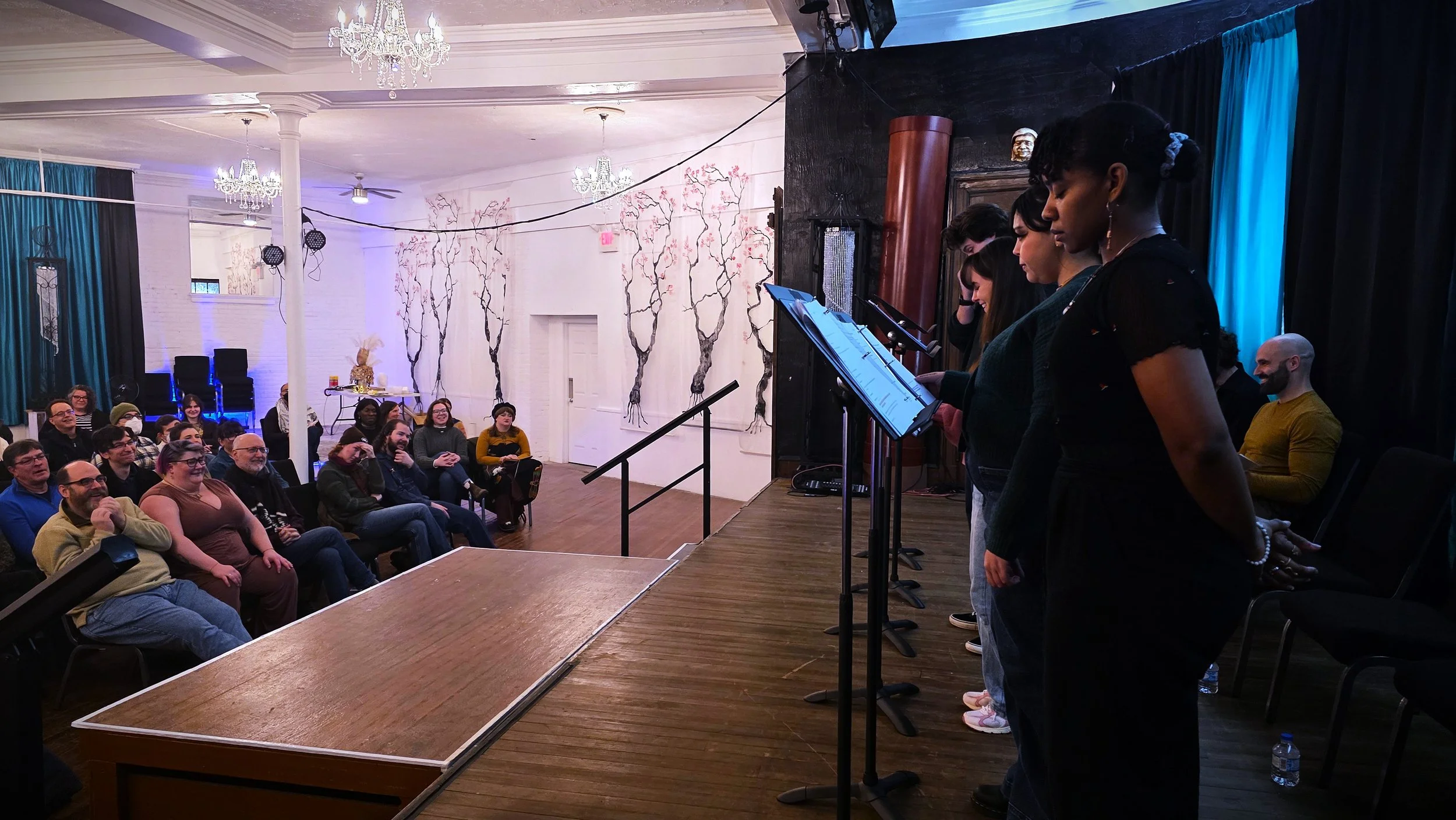
Music Stand Choreography: I could not decide for the life of me how to order these actors onstage. With a cast of 6 interconnected characters, there is such a deliciously tangled web of relationships. Readings usually ask actors to stand in a line facing the audience, standing the whole time or only to speak. But every order I could dream up left characters having intimate, vulnerable conversations 10+ feet away from each other. And I hated that. I wanted to preserve what I could of the intimacy, despite the actors needing their scripts. So, I numbered the music stands and the characters entered the scene by going to their assigned stand for that scene. This way, there were very few moments in which two characters were speaking vulnerably to each other from another zip code. There were also moments when the actors moved to another stand over the course of the scene. Playing with that distance allowed the audience to feel closer to what the characters were feeling: exposed vs private, intimate vs distant, etc. And I loved that it visually activated the space as well.
Audience Incorporation: Hellfire in particular was made for audience participation. So we incorporated it. The conceit of the play is that the audience is receiving a tour of a Hell House, an Evangelical take on the haunted house. While we couldn’t totally immerse the audience the way the final production aims to, there were a few instances where the actors didn’t have lines for just long enough that they could leave their script and actually interact with the audience. So we did it. When the Pastor comes in to greet the audience, we had him enter from the audience and shake their hands. He was able to make a delicious meal of the moment before he dove back into his script. And our “tour guide”, despite being reliant on his script, was very intentional with his eye contact. He clearly indicated when he was talking to the audience vs the other characters in the play. And because of that, we could cut out most of stage directions that said “He speaks to the audience” or “He turns back to the audience” etc., and just let him flow. While we couldn’t execute all the audience interaction that’s envisioned for the fully staged production, it makes that aspect of the show tangible for the reading audience.
Stage Directions: To me, stage directions are the most unique and interesting tool that a reading can utilize. I think a lot of people look at reading the stage directions as a necessary evil, but you can completely transform a reading with the choices you make about the stage directions. Which directions are spoken vs performed by the actors vs skipped entirely? How do we tweak the wording for flow or clarity? How can we play with delivery, tone, and pace to elevate the scene? A really effective reader of stage directions is as much a performer as anyone else in the reading. Stage directions don’t have to be neutral, they can be tongue-in-cheek and ironic, or anxious and erratic, or heavy and ominous, whatever serves and amplifies the atmosphere of that particular script.
And on that topic, I say: NO GIMMICKS. This is not a pro-cheap-stunts blog post. It’s not my desire to mindlessly add spectacle to artificially make readings more entertaining. Don’t mistake me, I LOVE spectacle. (I’m still waiting to work a show that requires a fake blood budget…) But I prefer spectacle that amplifies the text, not stomps all over it. Intentionality is everything, and not every translation tool suits every story.
To that point, I’m about to direct a reading of Forget About Me by David Hansen. (Come see it on June 13th! -salon4A.eventbrite.com or salon4B.eventbrite.com) This text is very different than Hellfire. While both Forget About Me and Hellfire are grounded in nuanced human relationships, Hellfire has a larger cast and focuses on a whole web of relationships, while Forget About Me is an intimate play between a mother and her teenage child. Forget About Me’s smaller cast, solid 4th wall, and single-take quality mean that many of the tools I used for Hellfire likely aren’t a good fit. The lack of scene changes means there probably won’t be much need for music stand choreography. The audience isn’t a part of the show, so audience interaction could be distracting. And most of what we need to know is in the dialogue, so the stage directions are fewer and further between. There isn’t a one-size-fits-all handbook for how to curate the unique magic of readings, but I so look forward to discovering the tools that will make this Forget About Me sing.