
DEVISING AS A DANCER - BY DAVID LENAHAN
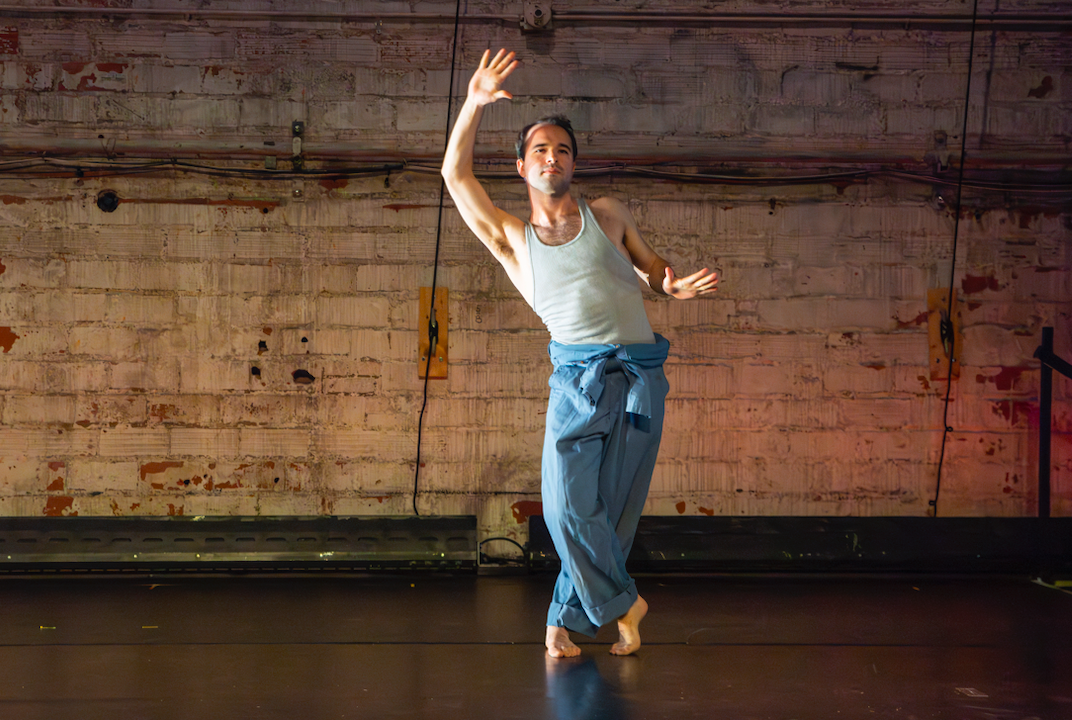
I love Dance. I love movement. My best friend has described me to several people as the most Kinesthetically Intelligent person he knows (see Howard Gardner’s Theory of Multiple Intelligences). I don’t really know about all that, but I do know that movement has become one of my favorite ways to express myself. Because of this I would be doing myself a great disservice to not bring my sense of movement and body awareness to my work as an actor. How this manifests in terms of finding and creating a character can look extremely different from project to project. In the past, it has included techniques such as Laban’s Efforts and Viewpoints work, or finding a character’s posture and physical ticks. For this extended rehearsal process for Elephant’s Graveyard, we explored several techniques that lend themselves quite well to an actor who, like me, is drawn to movement.
The Playthrough and the Freedom to Fail
In our first rehearsal in November, instead of the traditional Table Read of the script, we had a Playthrough. There was no table. Instead, there were chairs set in corners around a large open room and an invitation from Craig, our director, to walk, to move, to interact, and to make sound (or more generally, to Play) while we read the script aloud for the first time as a company. This invitation to try things with neither judgement nor fear of failure was a combination of daunting, freeing, and inspiring, and truly set the tone for the collaborative devising process to come.
The fear of failure is incredibly limiting, especially if you, like me, have a tendency towards perfectionism. This means that fighting against that need to be perfect is paramount to the exploration and freedom that are necessary for any creative or artistic pursuit. As a dancer, this can sometimes seem counterintuitive. “What are my steps? Where do I stand? What is the precise angle of my body?” In devising, there are no right answers. No choreographer to tell me what to do. No model to strive toward. Only the invitation, “if you have an instinct to try something, DO IT!”
The only way to find out if a sound, gesture, or acting choice does or does not work in a moment is to commit fully to trying it and then evaluating its effectiveness afterwards, either through personal spyback or with an outside observer who can see the whole picture. As a dancer learning a new step, jump, trick, etc, the only way you can do it, is if you have the courage to try and quite possibly fail (often many times) before you either master it, or decide that maybe backflips are not necessary for your personal journey as an artist after all... You have to be willing to strongly make the wrong choice. You have to be free to fail in order to have any hope of discovering Truth.
Gesturing with Intention and Movement as a Throughline
One of Michael Chekhov’s techniques that we explored in this process is Psychological Gesture (PG). I won’t try to define it here, but think about it for now as using movement—in this case a single, full-bodied gesture—to help generate an emotional intention. I find it to be an incredibly useful technique for discovering and clarifying moments, intentions and to help differentiate acting ‘beats’. I had the opportunity to work on several of my monologues individually with Scott, our Assistant Director. With his guidance in exploring these pieces using PGs, I was able to find a lot more depth and variety in not only my performance of the monologues themselves, but in my understanding of my character—‘Shorty’ the Trainer—as a whole. These PGs have for the most part not physically remained in how I have been performing the monologues, but the intentions and feelings generated by the PGs in my individual practice have definitely carried through.
There are other gestures that are not archetypal PGs that I have played with through rehearsal that have, as yet, physically remained in my performance. Feeding Mary a peanut, washing her, standing ‘On top of the world’. These are all motifs that show up in a variety of ways for Shorty throughout the play, and finding movement (a gesture, if you will) for each has felt like a natural way for me to connect them, both in my own head and for the audience. While at times this can feel a little more like choreography, my current thinking is that in a devised piece like ours, we don’t have to stay locked into realism, but have some room to play in different ways.
Are any of these gestures, seen or felt, effective for the story? I guess we won’t know until after we try it and see. For now, I’ll do my best to stay open to failing and hope I can find some Truth along the way.