
FINDING MY PLACE IN A NEW HERD - BY TRICIA BESTIC
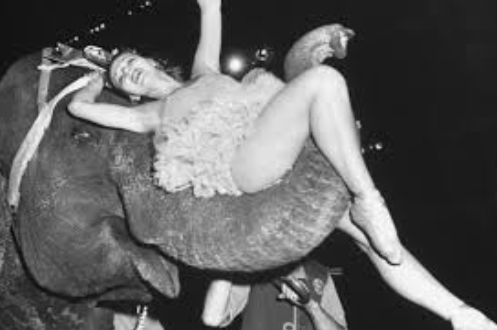
I walked into the rehearsal room without a map, which is not something I am accustomed to admitting, let alone doing. After years of working in the theatre, I have learned how to arrive with answers — or at least the appearance of them. I know how to read a room, how to prepare, how to make myself useful. I know the comfort of a script, the quiet authority of structure. This room only offered some of that. We were going to run through the show for the first time on our feet and play. Experience doesn’t eliminate vulnerability — sometimes, it heightens it.
Letting Go of “Knowing” – Experience Can Be Weight and Harden Into Expectation
It had been years (a little professional, but mostly grad school) since I’d been a part of devised theatre making. As a side note, I’d like to thank all my Michael Chekhov teachers for giving me the greatest gift of training they could. Even with all the training in the world, there is always pressure to “arrive prepared,” and to know who you are in the room.
This was my first time working with this company, and we were beginning Elephant’s Graveyard by George Brant as a devised piece. While there was a fixed text, there was no blocking (guided movement) spelled out waiting to catch me if I fell. Instead, there was space — generous, demanding space — and the expectation that I would listen before I spoke.
I felt my experience like a weight. Not pride, exactly, but a kind of gravity. Experience can be a gift, but it can also be a habit. It teaches you how to move efficiently through uncertainty, how to disguise not knowing. In a devised process, that instinct becomes a liability. There is nowhere to hide. Every impulse is visible. Every silence is an offering. I found myself resisting the urge to define anything too quickly. I wanted to be good. I wanted to be clear. I wanted to justify my presence. Instead, the work asked me to wait — to stand inside the discomfort of not being useful yet, not being legible yet. To trust that something would emerge if I did not rush to name it.
A Moment, Not an Explanation
Within this first rehearsal room, we began to develop a trust with each other- not with scripted words, but with the reaching out of hands, the shape shifting bodies, and a chorus of supportive sounds. Actors, artists, and facilitators formed an intimacy some people may never truly experience in a lifetime, grounded in the goal of bringing a circus to life.
We choose vulnerability, listening, and risk to reveal the truth. It is more about a shift from expertise to openness: listening more than leading, responding instead of planning, and connection above all else. When we devise, we are all beginners, and no choice is wrong. It’s just a learning tool, and I think it’s the true ability to let go and play that makes for great work.
Entering the Devised Unknown
Devised theatre asks for presence, not answers. It requires trust before certainty, and things like silence, repetition, and even failure become our teachers. With such a large ensemble you are shaped by the room rather than steering it. An ensemble can hold your choices or challenge them. There is a quiet generosity of shared creation.
My character “Ballet Girl” did not arrive all at once. She surfaced in fragments — a gesture repeated without meaning, a moment of stillness that felt heavier than it should have, a way of holding myself that I did not always consciously choose. In a process like this, you begin to recognize when something is not invented but revealed. Ballet Girl felt like that, as if she had been waiting for me to stop performing and to let her in.
After a lot of pondering, I decided to use an Irish dialect. This came mostly from instinct rather than strategy, although one must always look at the whole and assess what might be needed. It was not about accuracy or ornamentation; it was about access. The sound changed my breath. It allowed a distance between myself and the language that made honesty possible. The risk was immediate. Making a choice that specific in a room full of collaborators requires faith — faith that the room will hold it, faith that you can let it evolve without defending it.
What surprised me most was how quickly the ensemble became a mirror. Working with this company for the first time meant surrendering my familiar rhythms and learning new ones. I was held accountable in quiet ways — through attention, through listening, through the collective shaping of the work. The generosity of that process made bravery possible. It reminded me that devised theatre is not about asserting an idea, but about noticing when something true is already happening.
Grateful and Grounded
As we move towards performance, I find myself standing inside Elephant’s Graveyard with a renewed sense of humility. Ballet Girl continues to teach me how to listen — to the room, to the story, to the parts of myself that do not need to be certain in order to be present. This piece was built slowly, collaboratively, and with great care, and it carries the imprint of everyone who stood in the room together. At this point in my career, I am grateful to be reminded that the work does not ask us to arrive fully formed. It asks us to stay open long enough to be changed. I hope audiences will come sit with us in that shared space — not to be given answers, but to witness what can emerge when a story is allowed to grow from listening.