DIRECTING ON A SHOESTRING - BY JEANNINE GASKIN
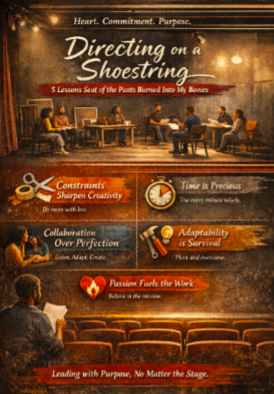
AKA 5 Lessons Seat of the Pants Burned into My Bones
When you work at Seat of the Pants, you don’t have the luxury of excess: excess money, excess bodies, or excess resources. What you do have is heart, commitment, and a deep belief that the work matters. Over time, directing and producing in that environment doesn’t just teach you theatre skills; it rewires how you approach leadership, creativity, and problem-solving in every area of your life.
Directing on a shoestring isn’t about doing less. It’s about doing what matters most with intention. These are the five lessons Seat of the Pants burned into my bones and how I’ve carried them far beyond the rehearsal room.
1. Constraints Don’t Kill Creativity; They Sharpen It
When you don’t have a massive budget or elaborate technical elements, every choice has to earn its place. You ask different questions:
What is essential? What tells the story best? What can we strip away without losing the heart?
Constraints force me to direct/produce with clarity. I lean into storytelling, performance, and human connection.
How I’ve applied this elsewhere:
In my professional and entrepreneurial work, I no longer wait for “perfect conditions.” Whether I’m producing a community event, building a new program, or leading a work initiative, I work with what’s available and move forward. Constraints now feel like a challenge, not a barrier.
2. Time Is the Most Precious Resource You’ll Ever Manage
Rehearsal schedules are tight. Load-ins are fast. Tech time is sacred. Seat of the Pants taught me quickly that you cannot waste people’s time, not actors’, not designers’, not volunteers’. Every rehearsal must be purposeful. I learned to plan thoroughly so we could work efficiently, not frantically.
How I’ve applied this elsewhere:
This lesson shows up daily in my corporate work and creative projects. Meetings have agendas. Goals are clear. Preparation happens before people gather. I’ve learned that respecting time is one of the purest forms of respect you can offer.
3. Collaboration Beats Perfection Every Time
When resources are limited, you cannot afford ego. You need the room. You need ideas. You need buy-in. Seat of the Pants reinforces that the best work comes from listening, adjusting, and co-creating. Some of the strongest moments I’ve been part of didn’t come from my original vision: they came from an actor’s insight, a designer’s suggestion, or a stage manager’s problem-solving brilliance.
How I’ve applied this elsewhere:
Whether I’m leading a team, mentoring someone, or producing a large-scale cultural project, I prioritize collaboration over control. I’ve learned to let go of needing to be “right” in favor of getting it right together.
4. Adaptability Is Not Optional… It’s Survival
Something will go wrong. Someone will get sick. A prop will break. A line will land differently than expected. At Seat of the Pants, adaptability is not a bonus skill, it is required. I have learned how to pivot quickly without panicking, to recalibrate without blame, and to keep the larger vision intact even as the details shifted.
How I’ve applied this elsewhere:
Life rarely follows the plan. Whether I’m navigating organizational change, managing competing priorities, or balancing multiple roles, I now approach challenges with flexibility. Instead of asking “Why is this happening?” I ask, “What’s needed now?”
5. Passion Sustains What Money Cannot
Seat of the Pants runs on belief: belief in the work, belief in the artists, belief in the audience. People show up because they care. They stay late. They problem-solve. They give more than what’s required. Being in that environment reminds me that passion isn’t fluff, it’s fuel.
How I’ve applied this elsewhere:
In every project I choose, I now ask: Does this align with my values? Does this matter? Passion is what carries me through long days, tight deadlines, and complex challenges. When the “why” is strong, the “how” becomes possible.
Final Curtain Call
Directing and producing at Seat of the Pants hasn’t just make me a better theatre artist; it has made me a better leader, collaborator, and human being. It has taught me how to value people over polish, and how to create meaningful work even when resources are scarce.
These lessons now follow me into community spaces, corporate spaces, classrooms, and living rooms. When you learn how to direct on a shoestring, you learn how to lead with purpose and that lesson lasts a lifetime.
Written in gratitude for the artists and collaborators who prove that heart is the greatest resource of all.