
BEFORE THEY BECAME WHO THEY ARE - BY RICKY QUINTANA
SPOILER ALERT: This post reveals a surprise plot point of the play; if you want to be surprised, read this after you see the show. :)
Lately, it feels like everyone is revisiting their past selves online. From sound-driven nostalgia edits (my current favorite uses Iris by the Goo Goo Dolls) to the whole “2026 is the new 2016” trend, there’s no shortage of content built around looking back at who we used to be. And that’s exactly what we’ve been doing in rehearsal for The Book Club Play!
Recently, our director, Chris Bohan, gave us an exercise called “Primary Event.” The idea is simple, but kind of profound: create an inciting incident for your character that happens before the play even begins.
So the question becomes “how do you build a past for someone who doesn’t technically exist?” Sure, the playwright gives us clues. But a lot of it is on us as actors to fill in the blanks - to imagine a full, lived-in human based on what’s on the page.
Before this assignment, we had already been doing a lot of exploratory work. We ran mini improvisations (or etudes) based on different relationships in the play. I got to explore Will’s dynamic with his best friend Rob and his co–book club founder Ana. We improvised Will and Ana on one of their first dates. Then we jumped into Will and Rob hanging out during their first few weeks of college. And those moments? They unlocked a lot. When it came time to create my “primary event,” I found myself circling three big ideas.
First: authenticity. Chris had named it as one of the central themes of the play, and it stuck with me. I kept asking myself: What does it actually mean to be authentic? And how much of our identity is tied up in that idea?
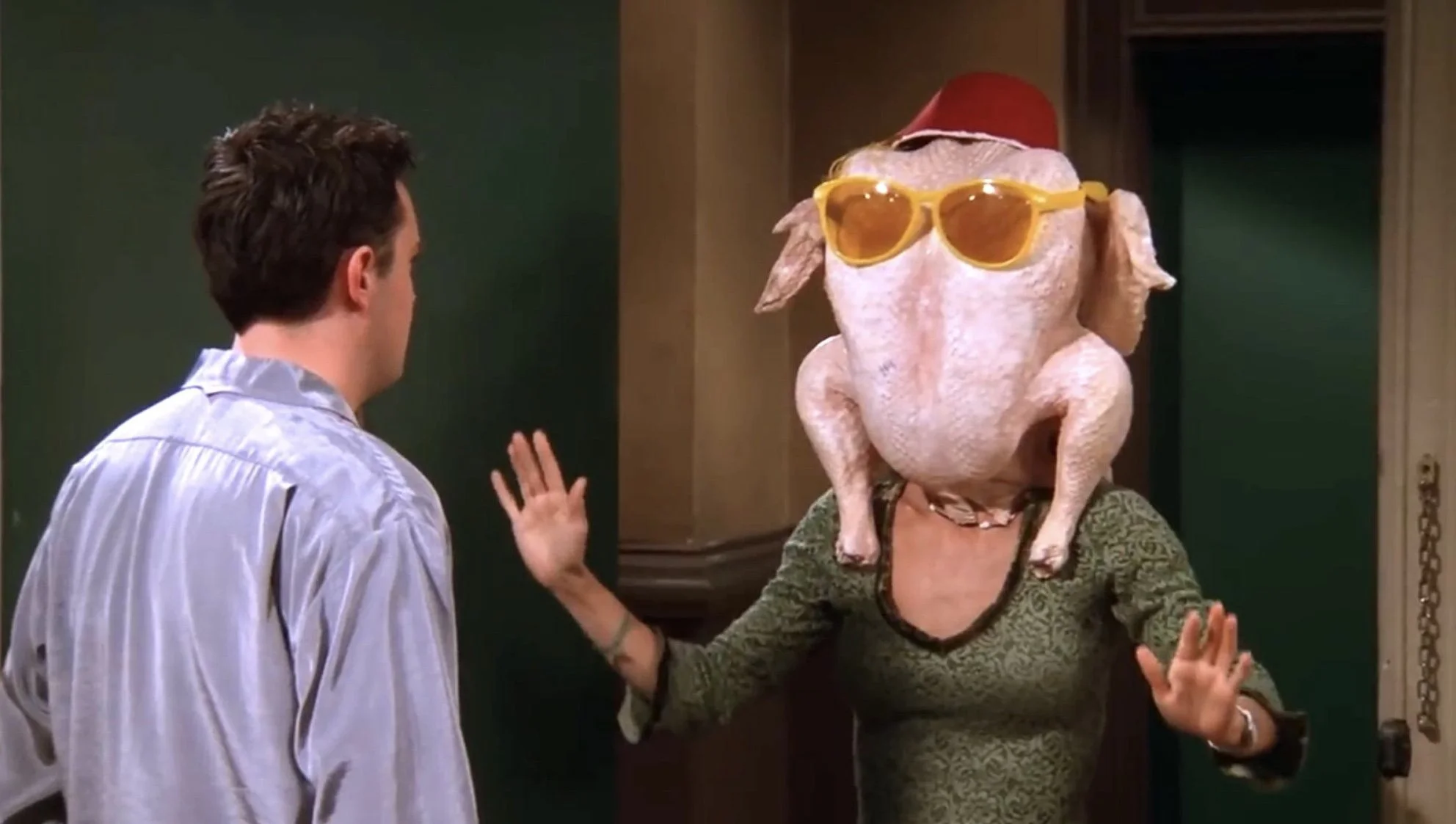
Second: sitcom flashbacks. Specifically, “The One With All the Thanksgivings” from Friends. You know the one where we see earlier versions of the characters: Monica is younger and deeply insecure, Chandler is sharper and more guarded, Ross is awkward and trying too hard, Rachel is still living in her high school bubble. Those flashbacks are hilarious, but they’re also doing something deeper. They show us where these people started. They give us the emotional blueprint.
And third: Will’s journey in the play. One of his major turning points is coming out as gay, so I knew whatever I created had to somehow connect to that unfolding.
From there, three possible “primary events” emerged.
In one, someone flirts with Will while he’s at work (the script tells us he’s a curator of Greek antiquities at a museum). It felt like a small but meaningful crack in the foundation - something that might quietly start to shift how he sees himself.
In another, he thinks he’s about to get promoted… and instead gets fired. Since so much of his identity is tied to his job, losing it would force a much bigger question: If I’m not this, then who am I?
And in the third, he goes to a gay bar after work. Not with a plan, just curiosity. That moment felt like planting a seed. A first step toward seeing a version of himself reflected back in the world.
When I shared these with Chris, he smiled (which should have been my first clue) and said: “Great. Let’s do all three.”
And honestly, I loved it.
As we started improvising, I found myself thinking about those Friends flashbacks again. I wasn’t just explaining Will’s past: I was playing it. Letting it be messy, specific, a little heightened. Almost like stepping into a different version of his body for a few minutes. With the help of my cast mates, those moments came to life in ways I didn’t expect. And suddenly, they weren’t just ideas anymore: they were active forces shaping how I understood Will in the present.
That’s the thing I keep coming back to: character backstory isn’t just information. It’s playable. The past isn’t quiet or distant. It’s alive. It’s physical. It shows up in how a character moves, speaks, deflects, reaches.
In a way, exploring a character’s past feels a lot like those sitcom flashbacks. You’re not just learning what happened: you’re stepping into who they were before they figured things out. Before the polish. Before the defenses fully set in. When we do that kind of work as actors, we’re not just filling in blanks. We’re bringing history onto the stage.
And I can’t wait for audiences to see the layers of that history unfold in The Book Club Play.