DISCOVERING THE WORLD OF ELEPHANT'S GRAVEYARD - BY STACEY COSTANZO
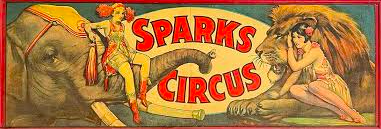
As a scenic designer, I think of my job in part as visually defining the time and place of the story. For Elephant’s Graveyard, that answer seems simple: Erwin Tennessee, 1916. Yes, it is true that our story takes place in a town called Erwin in the state of Tennessee in the year 1916, but the people of Erwin are not the only players to consider when building the world onstage. There were three distinct entities I needed to consider when I began looking at designing the show: a town, a circus, and a railroad. All three of these groups needed to feel distinct from one another, yet at home on stage. Playwright George Brant left a helpful note in the script suggesting that, “the set may be an empty stage or an abstract collision of the worlds of the circus, town and railroad. This collision need not be pretty”. That may not mean much to you, but it was enough to get me rolling.
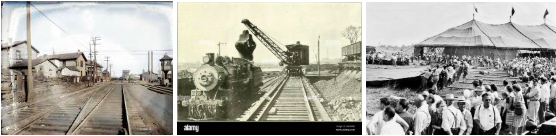
The first thing I did was think about what visually defines each of those groups for me on the simplest of levels. I really do mean the simplest of levels. I really try to begin by breaking down these big ideas to the core thing that sticks in people's minds. Imagine you’re playing a game of Pictionary and think about the image you would draw to get your team to guess ‘circus’, or ‘town’, or ‘railroad’. What is the one thing that visually defines it? That’s what I looked for. It’s not always an easy task, and more often than not I move away from these initial visuals relatively quickly. For Elephant, I thought about the town first. Main street. Dusty roads. Boardwalks. Then I thought about the railroad’s steel, coal, and machinery. And then the circus where there was one visual that stood out in my mind more than any other- the big top circus tent.
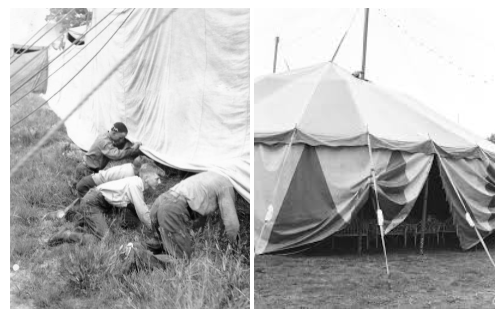
It’s such a strong visual, and I couldn’t get it out of my head. I knew it was next to impossible to do a show with a circus and not have a big top tent represented so I started doing research on what historically accurate circus tents looked like. I focused on shapes and defining elements like ropes, stripes, and the way the fabrics draped.
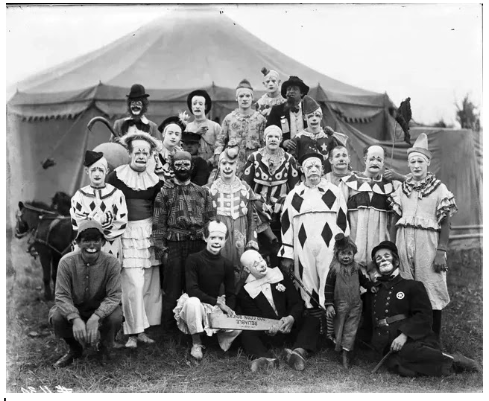
At this point, Craig and I had a few creative conversations about the show. During those conversations we talked about embracing a non-traditional theater venue and placing the audience as close to the action of the play as possible. We brainstormed ways that we could accomplish that in a large space that isn’t usually intended for theater. How can we define a playing area without a proscenium? An idea we tossed out at this stage was the idea to play the show in the round- with the stage being surrounded on all sides by the audience. This felt like such an ‘aha’ moment for me, because you know what else famously plays in the round? The circus.
I started thinking about the idea of our audience existing within the world of the play as the circus’ audience. As I thought about it more, I narrowed my research into what the inside of the circus tents looked like.
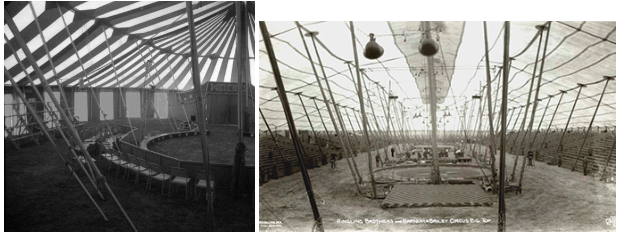
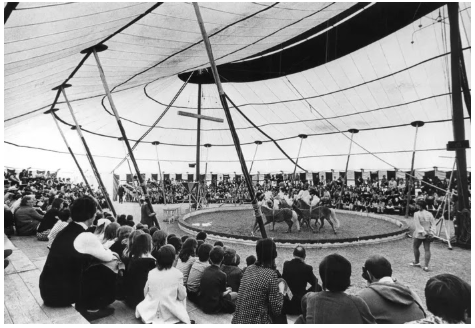
This felt like my framework. I wanted to design a version of a circus tent that would not only define our playing space, but encapsulate our audience as well as our actors inside the world of our play.
I’m sure at this point you’re thinking to yourself, “well that’s got the circus covered, now what about the town and the railroad?” Don’t worry; I didn’t forget about them. What’s lovely about working in a collaborative art form like theater is that my designs do not exist in a vortex. I plan to pull colors from the costumes (designed by Jenniver Sparano) of the townspeople and the railroad when creating the structure so while the shape might feel like the world of the circus, it will also exist in the world of the town and railroad. Hopefully, my design will provide the perfect blank canvas for our ensemble to transform into the world of 1916 Erwin Tennessee.